
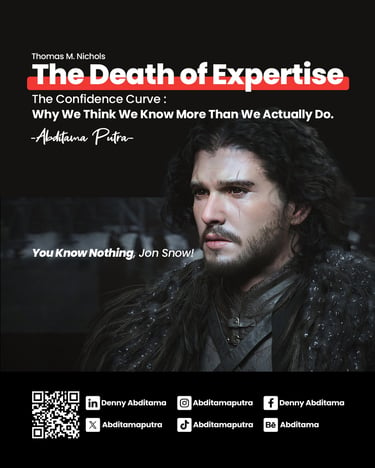
The Death of Expertise. The Confidence Curve : Why We Think We Know More Than We Actually Do
The book “The Death of Expertise” by Thomas M. Nichols- honestly, it hit me in many personal experiences like a delayed invoice. Ever noticed how the loudest people often know the least? They speak in buzzwords, host flashy webinars, claiming too many positions and experience titles, and drop “strategy” like it’s confetti. But plot twist: A lot of these “experts” are running talk-only webinars with no real-world success, no receipts. They talk like a CEO but couldn’t run a lemonade stand. Selling vibes, not value. Add some Canva slides, and boom—thought leader.
PEOPLE
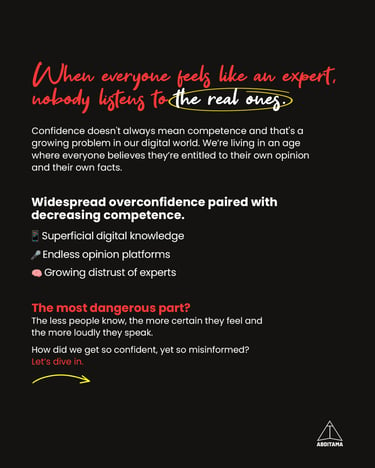
When Everyone Feels Like an Expert, Nobody Listens to the Real Ones.
We’re living in an era where confidence is increasingly detached from competence. Information is abundant, opinions are limitless, and algorithms amplify certainty more effectively than truth. The result is widespread overconfidence paired with declining depth of knowledge, growing distrust of experts, and an environment where everyone feels qualified to speak—even when few are willing to verify what they’re saying.
The most dangerous part isn’t that people know too little. It’s that many don’t realize how little they know. The less informed someone is, the easier it becomes to feel certain, and the louder they’re often willing to speak.
Perhaps the greatest lesson from The Death of Expertise is that expertise still matters, but recognizing it has become harder than ever. In a world full of confident voices, we should spend less time asking “Who sounds the smartest?” and more time asking “Who has actually done the work?”
Because in the end, confidence may capture attention, but competence is what creates lasting results.
WHAT’S HAPPENING TODAY
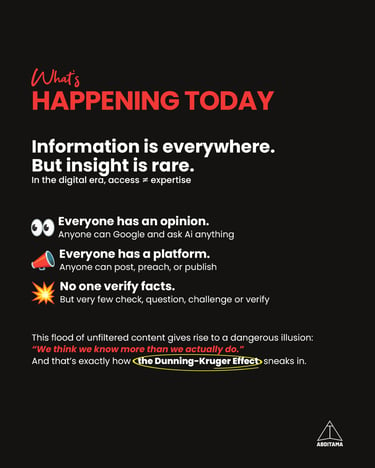
Information Is Everywhere. But Insight Is Rare.
The internet has democratized access to information in ways previous generations could never imagine. Today, almost anyone can learn a new skill, research a topic, or generate answers within seconds using Google or AI.
Unfortunately, access to information is not the same as understanding it.
Everyone now has an opinion because everyone has access to endless content. Everyone has a platform because publishing ideas requires nothing more than a smartphone. Yet very few people invest time verifying facts, questioning assumptions, or examining opposing perspectives before sharing their conclusions.
The result is a flood of opinions masquerading as expertise.
This creates a dangerous illusion: because information is so easily available, we begin believing we understand subjects far better than we actually do. The gap between knowing about something and truly understanding it becomes invisible.
That illusion is exactly where the Dunning-Kruger Effect quietly thrives.
DUNNING-KRUGER Effect
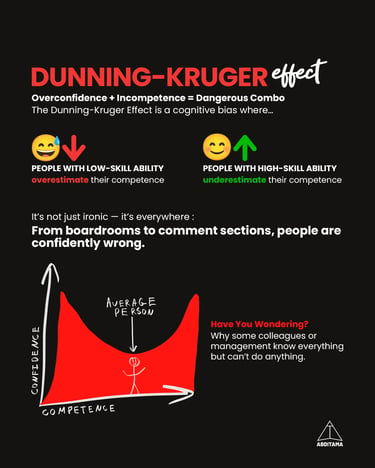
Overconfidence + Incompetence = Dangerous Combo
The Dunning-Kruger Effect is a cognitive bias describing a surprisingly common phenomenon: people with lower levels of knowledge or skill often overestimate their competence, while highly skilled individuals frequently underestimate their own abilities.
This happens because the skills required to perform well are often the same skills needed to accurately evaluate one’s own performance. When people lack expertise, they also lack the awareness to recognize what they don’t know. Ironically, those who know the least often feel the most certain.
On the opposite end of the spectrum, genuine experts tend to be far more cautious. Because they understand the complexity of a subject, they recognize its limitations, exceptions, and unanswered questions. The more they learn, the more they realize how much remains unknown.
That’s why you’ll often see the least experienced person speaking with complete certainty, while the most experienced person carefully considers every possibility before answering.
It isn’t just an amusing psychological quirk it’s everywhere. From corporate boardrooms and startup meetings to LinkedIn comment sections and viral Twitter threads, people are confidently wrong every single day.
It also explains why some colleagues or even leaders appear to know everything in meetings but struggle when it’s time to execute. Confidence can create the illusion of competence, but results eventually reveal the difference.
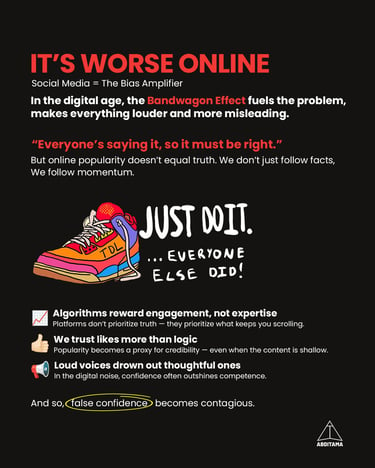
IT’S WORSE ONLINE
Social Media = The Bias Amplifier
If the Dunning-Kruger Effect exists naturally, social media magnifies it dramatically.
Digital platforms don’t reward accuracy; they reward attention. Algorithms prioritize engagement, emotional reactions, controversy, and certainty. The more confidently someone speaks, the more likely they are to be shared, liked, and recommended, regardless of whether they’re actually correct.
This creates the perfect environment for another psychological phenomenon: the Bandwagon Effect.
When thousands of people repeat the same message, we subconsciously assume it must be true. Popularity begins replacing evidence. Viral content starts looking credible simply because everyone is talking about it.
As a result, engagement becomes more valuable than expertise. Likes become a substitute for logic. Loud voices drown out thoughtful ones, while nuanced explanations struggle against catchy one-liners.
Eventually, false confidence spreads like a contagious virus, not because it’s accurate, but because it’s highly visible.
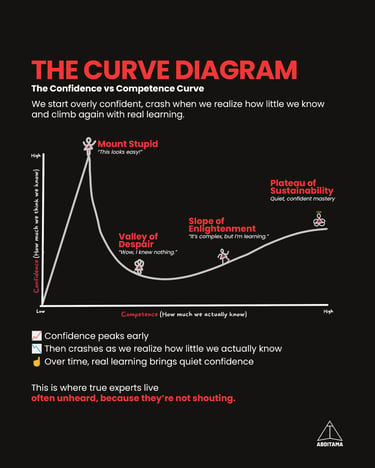
THE CURVE DIAGRAM
The Confidence vs Competence Curve
One of the best ways to understand the Dunning-Kruger Effect is through the Confidence vs. Competence Curve.
At the beginning of any learning journey, confidence rises incredibly fast. After reading a few books, watching several YouTube videos, or completing an online course, people often feel they’ve mastered the subject. This first peak is commonly called Mount Stupid, where enthusiasm is high but actual understanding remains shallow.
As reality sets in and deeper challenges emerge, confidence crashes into what is known as the Valley of Despair. Here, learners realize how much they don’t know. It can be discouraging, but it’s also where genuine learning truly begins.
Those who continue practicing, experimenting, failing, and improving eventually enter the Slope of Enlightenment. Confidence slowly returns—not because they’re pretending to know everything, but because they’ve developed real competence through experience.
Finally comes the Plateau of Sustainability, where true experts reside. They are quietly confident, comfortable admitting uncertainty, and far less interested in appearing intelligent than in continually improving.
Ironically, these are often the people we hear the least because they aren’t trying to dominate every conversation. They’re busy doing the work.
REAL-WORLD EFFECTS
“Confident but Clueless” vs. “Quiet but Brilliant”
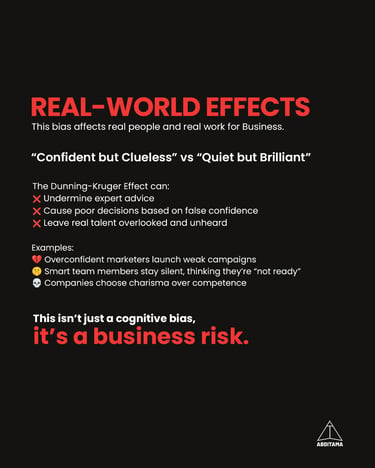
The Dunning-Kruger Effect isn’t merely an interesting psychological concept; it has real consequences for businesses, organizations, and society.
When confidence consistently outranks competence, poor decisions become inevitable. Experienced professionals are ignored, while persuasive communicators gain influence despite lacking practical expertise. Talented individuals stay silent because they feel “not ready,” while less qualified voices dominate discussions. This pattern appears everywhere.
Overconfident marketers launch campaigns built on assumptions rather than research. Skilled employees hesitate to contribute because they underestimate their own expertise. Organizations promote charisma instead of capability, confusing presentation skills with leadership.
The cost isn’t simply bad ideas; it’s missed opportunities, weakened teams, and expensive decisions. In business, this isn’t just a cognitive bias. It’s a business risk.
WHAT CAN WE DO ABOUT IT
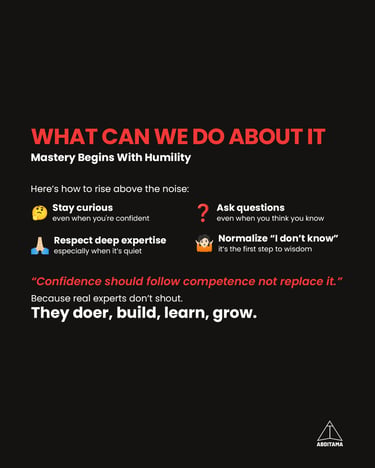
Mastery Begins With Humility
The solution isn’t becoming less confident. It’s making sure confidence follows competence rather than replacing it.
Real mastery starts with curiosity. Stay willing to ask questions even when you think you already know the answer. Seek out people with deeper expertise, especially those who aren’t constantly promoting themselves. Normalize saying, “I don’t know,” because acknowledging uncertainty is often the first step toward genuine understanding.
The best professionals remain lifelong learners. They question their assumptions, challenge their own thinking, and continually refine their knowledge through experience.
Confidence should be the outcome of competence. Not a substitute for it. Real experts rarely shout. They’re too busy building, learning, solving problems, and helping others grow.
© 2026 Abditamaputra – Inspired to Inspire.