
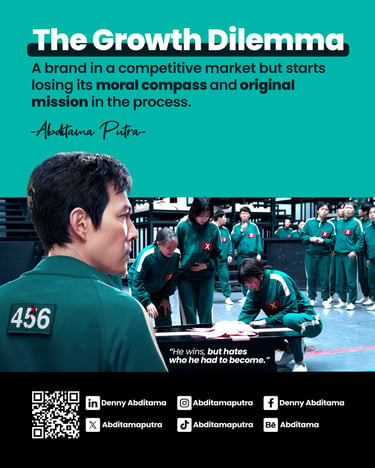
The growth dilemma. A brand in a competitive market but starts losing its moral compass and original mission in the process.
Welcome to The Brand Games. Where every brand wants to grow and survival isn’t about who’s loudest. It’s about who can grow without losing themselves. Like Seong Gi-hun: Started with a mission. Chased the numbers. Now trapped between loyal fans, noisy trends, and a full-blown identity crisis. “He won, but hates who he had to become.”
BRAND
The Growth Dilemma
A brand in a competitive market but starts losing its moral compass and original mission in the process.
Welcome to The Brand Games, where every brand is convinced that the next customer will solve all of its problems. Market share becomes the scoreboard, growth becomes the obsession, and every quarterly report feels like another round of Squid Game. The pressure is real. If you’re not expanding, someone else is.
At first, the mission is usually clear. A company launches to solve a problem, challenge an industry, or create something people genuinely need. Then growth arrives, along with new audiences, new competitors, new investor expectations, and a constant stream of advice telling the brand to “move faster,” “broaden the market,” or “appeal to everyone.”
That’s where things get complicated.
Think of Seong Gi Hun. He entered the game with a purpose that felt deeply personal. But as the rounds progressed, survival demanded compromise after compromise until he eventually won… yet no longer recognized the person staring back at him. As the series puts it, “He wins, but hates who he had to become.”
Brands experience the same transformation. They don’t wake up one morning and decide to abandon their purpose. It happens gradually through hundreds of tiny decisions. One campaign aimed at a new audience. One product that doesn’t quite fit the brand. One trend that promises reach but quietly weakens identity. Before long, the brand has more customers than ever, yet fewer people can clearly explain what it actually stands for.
This is what Annie Wilson and Ryan Hamilton describe as The Growth Dilemma. The greatest risk to a growing brand isn’t always aggressive competitors. More often, it’s the temptation to chase every opportunity until the original mission becomes impossible to recognize.
Growth isn’t the enemy. Unfocused growth is. Because the brands that survive the longest aren’t necessarily the ones growing the fastest. They’re the ones that know exactly what they’re willing to become and, more importantly, what they’re not.
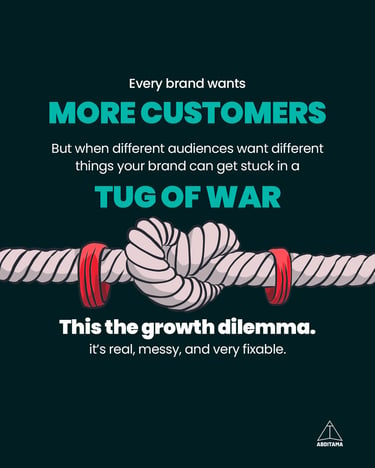
Every Brand Wants More Customers
Every business dreams about expanding its customer base. More customers usually mean more revenue, bigger market share, happier investors, and more screenshots for the annual report. Nobody has ever walked into a board meeting and proudly announced, “Good news everyone, we intentionally stayed exactly the same.”
The challenge begins when growth introduces audiences with completely different expectations.
Imagine your original customers love you because you’re simple, affordable, and authentic. Then a premium audience arrives asking for luxury features. Another segment wants faster delivery. Another demands sustainability. Yet another only cares if your product goes viral on TikTok. Suddenly, your brand isn’t having one conversation anymore. It’s having ten conversations at the same time.
This creates what marketers often experience as a tug of war.
Every new segment pulls the brand toward its own preferences. Product teams want new features. Marketing wants new messaging. Sales wants broader appeal. Leadership wants bigger numbers. Meanwhile, the original customers, the people who helped build the brand in the first place, begin wondering why their favorite brand suddenly feels… different.
The result is messy, but completely normal.
Growth isn’t a straight line. It’s a constant balancing act between attracting new audiences without confusing existing ones. Every brand eventually reaches the point where saying “yes” to one customer group unintentionally means saying “not really” to another.
That’s the real Growth Dilemma. Not whether to grow, but how to grow without pulling your identity apart from every direction.
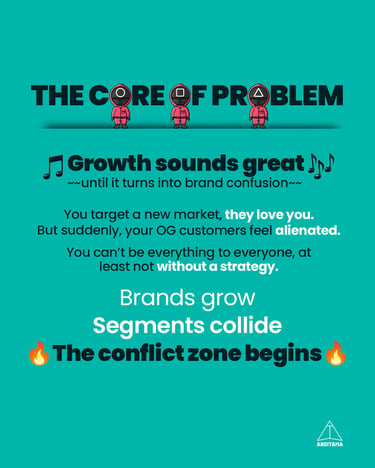
The Core of the Problem
Growth sounds exciting. It looks fantastic in investor presentations, annual reports, and LinkedIn announcements. More customers, more products, more markets, more opportunities. What’s not to love?
Well… brand confusion, for starters.
Many companies celebrate every new audience they attract without asking a far more important question: What will our existing audience think about this?
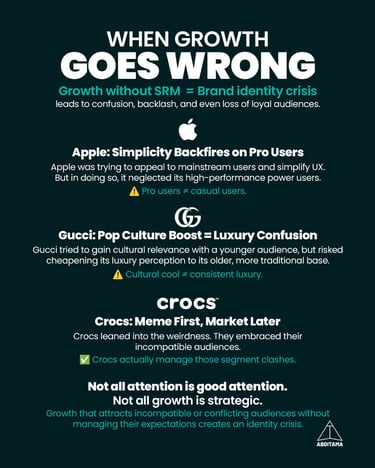
A brand may successfully attract younger consumers through playful campaigns while unintentionally making long time customers feel forgotten. Or it may introduce premium offerings that impress affluent buyers but alienate the people who loved its accessibility.
Ironically, both audiences can be happy individually while the brand itself becomes increasingly difficult to define.
This is where many brands accidentally become “everything for everyone,” which usually translates into “nothing memorable for anyone.”
Growth itself isn’t the problem. The absence of a strategy is.
Expanding into new segments should never mean abandoning the people who trusted your brand first. Every decision should strengthen the brand’s identity rather than dilute it. Because once customers begin asking, “Wait… what does this brand actually stand for now?” you’ve entered the conflict zone.
And unlike Squid Game, there’s no giant doll to warn you that you’ve crossed the line.
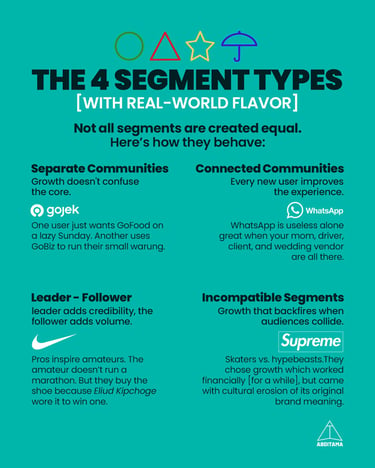
Segment Relationship Management (SRM)
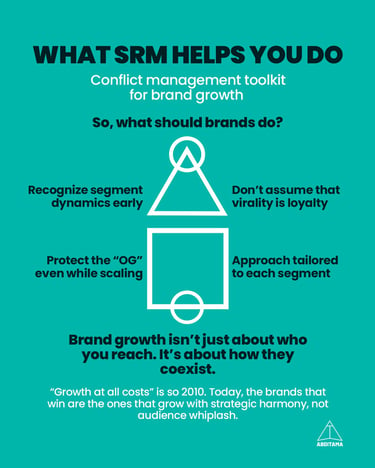
So how do brands keep growing without losing themselves?
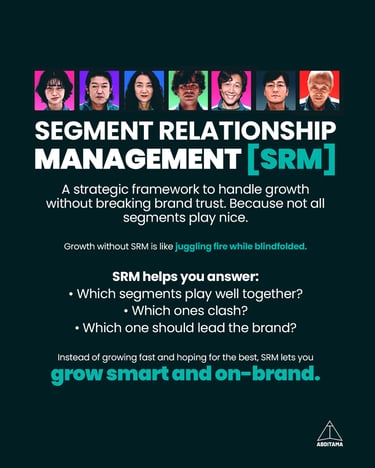
One answer is Segment Relationship Management (SRM), a strategic framework that focuses not only on acquiring new audiences but also on understanding how different customer segments interact with one another.
Most segmentation models stop after identifying who the customers are. SRM goes a step further by asking a more strategic question:
How do these segments affect each other?
Some customer groups naturally reinforce one another. Others compete for attention, reshape brand perception, or even create friction that weakens trust across the entire customer base. Without understanding these relationships, growth becomes surprisingly risky.
Launching a premium product may strengthen perceptions among affluent buyers while making value-driven customers feel excluded. Pursuing mass market awareness might boost sales but reduce the exclusivity that loyal premium customers once appreciated. Every new segment changes the ecosystem, not just the revenue chart.
That’s why growth without SRM is a bit like juggling flaming torches while blindfolded. You might impress everyone for a while, but eventually gravity gets involved. SRM helps marketers make smarter decisions by answering questions such as:
Which customer segments naturally complement each other?
Which audiences create conflict when targeted simultaneously?
Which segment should define the brand’s identity?
Which opportunities are worth pursuing, and which should be intentionally ignored?
The objective isn’t to maximize the number of customer segments. It’s to maximize the strength of the brand while growing sustainably.
The strongest brands understand that not every customer needs the same message, but every message should still feel like it comes from the same brand. That’s how companies expand into new markets without sacrificing the trust they’ve spent years building. Because in the long run, smart growth beats fast growth. Every single time.
© 2026 Abditamaputra – Inspired to Inspire.